Enclosed Charge
When using Gauss’s law, one must draw an imaginary volume in space and compute how much charge is inside the volume. Note that “charge enclosed” and “charge inside” are used interchangeably.
In general, the imaginary volume chosen is one for which computation of the electric flux is easy. That is, the imaginary volume will be such that the electric field is either parallel or perpendicular to all parts of the surface. In this activity, you are given the Gaussian volume. However, you should understand the reason for the choice of each Gaussian volume given.
There are three types of charge densities: linear (), surface (), and volume ().
Given a , and assuming is uniformly distributed on (or within for a volume) an object, to find
-
, divide by the length over which the charge is spread;
-
, divide by the area over which the charge is spread; and
-
, divide by the volume over which the charge is spread.
To find given a charge density, multiply the charge density by the relevant length, area, or volume.
Key formulas:
-
– circumference of a circle
-
– surface area of sphere of radius
-
– surface area of curved part of cylinder of radius and height
-
– surface area of cap of cylinder of radius
-
– volume of cylinder cylinder of radius and height
-
– volume of sphere of radius
-
A total charge of is uniformly distributed on a wire of negligible thickness that forms a circle of radius . What is the charge density?
Answer The appropriate density type is a linear charge density because the charge is uniformly distributed along a line. .
-
A total charge of is uniformly distributed on only the curved part of a cylinder of radius and height . What is the surface charge density?
Answer: The surface charge density of the curved part is divided by the area over which the charge is distributed, which is : .
-
A total charge of is uniformly distributed on the two end caps of a closed cylinder of radius and height . What is the surface charge density?
-
A total charge of is uniformly distributed on the surface of a sphere of radius . What is the surface charge density?
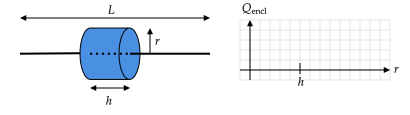
A total charge of is uniformly distributed on a non–conducting line of length . The Gaussian cylinder shown has a length , radius , and the same center line as the charged line.
-
Find the linear charge density, , on the line.
-
Find an equation for in terms of and one or more of , , and .
-
Use your equation from 2. to find the amount of charge enclosed by the Gaussian cylinder when it has radii of , , , and .
-
Plot the four values of enclosed charge calculated above versus the radius of the Gaussian cylinder. Then, plot the equation found in part 2. as one or more smooth curves or lines.
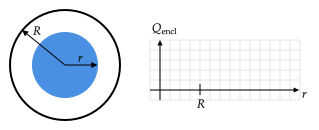
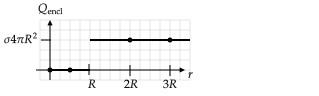
A non–conducting spherical shell of radius has a charge of uniformly distributed on its surface. Its cross–section is shown along with that of a Gaussian sphere of radius with the same center as the charged shell.
-
Find the surface charge density on the sphere.
-
Find an equation for for .
-
Find an equation for for . Your equation should involve and one or more of and .
-
Find the amount of charge enclosed in the Gaussian sphere of radii , , , and .
-
Plot the four values of enclosed charge calculated above versus the radius of the Gaussian sphere. Then, plot the equations found in parts 2. and 3. as one or more smooth curves or lines.
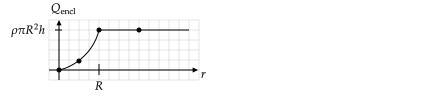
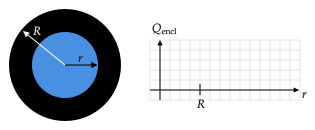
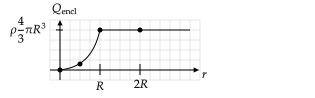
A non–conducting solid sphere of radius has a charge of distributed uniformly throughout it. Its cross–section is shown along with that of a Gaussian sphere of radius with the same center as the charged sphere.
-
Find the charged sphere’s volume charge density, .
-
Find an equation for for . Your answer should involve and one or more of and .
-
Find an equation for for . Your answer should involve and one or more of and .
-
Find the amount of charge enclosed in Gaussian sphere of radii , , , and .
-
Plot the four values of enclosed charge calculated above versus the radius of the Gaussian sphere. Then, plot the equations found in parts 2. and 3. as one or more smooth curves or lines.
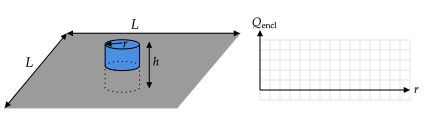
A non–conducting square sheet with side length has a charge of distributed uniformly on it. It is shown with a Gaussian cylinder of height and radius that is centered on the sheet, with half of it above the charged sheet.
-
Find the surface charge density, , of the sheet.
-
Find an equation for for . Your answer should involve and one or more of , , and . (In Gauss’s law problems, is much larger than , so we do not need to consider .)
-
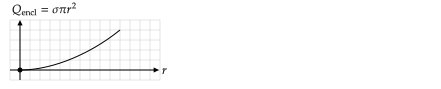
Plot the enclosed charge calculated above versus the radius of the Gaussian cylinder.
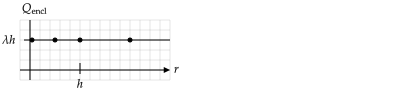
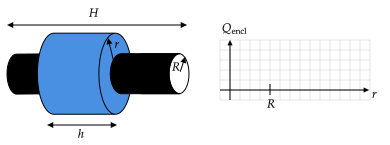
A non–conducting hollow cylinder of radius and length has a charge of uniformly distributed on its curved surface. The Gaussian cylinder shown has a length , radius , and the same center line as the charged cylinder.
-
Find the linear charge density, , of the charged cylinder.
-
Find an equation for for .
-
Find an equation for for . Your equation should involve and one or more of , , and .
-
Find the amount of charge enclosed by the Gaussian cylinder when it has radii of , , , and .
-
Plot the four values of enclosed charge calculated above versus the radius of the Gaussian cylinder. Then plot the equations found in parts 2. and 3 as one or more smooth curves or lines.
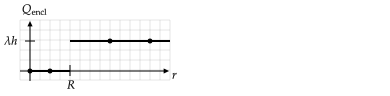
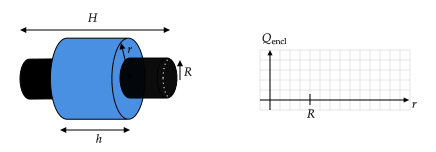
A non–conducting solid cylinder of radius, and length has a charge of uniformly distributed throughout it. The Gaussian cylinder has length , radius , and the same center line as the charged cylinder.
-
Find the volume charge density, , of the charged cylinder.
-
Find an equation for for . Your equation should involve and one or more of , , and .
-
Find an equation for for . Your equation should involve and one or more of , , and .
-
Find the amount of charge enclosed in a Gaussian cylinder of radius , , , and .
-
Plot the four values of enclosed charge calculated above versus the radius of the Gaussian cylinder. Then, plot the equations found in parts 2. and 3. as one or more smooth curves or lines.