Equivalent Resistance
The current in all parts of a circuit with resistors and batteries can always be found by writing equations for KCL and KVL and solving for the unknown currents. This was the approach taken in the Kirchhoff’s law activity.
There is an alternative approach that is often faster:
-
replace resistors in series or parallel with equivalent resistances to create a new circuit. If no resistors in the new circuit are in series or parallel, skip to step 3.
-
repeat step 1.
-
Use KCL and KVL to find currents in the remaining equivalent circuit.
In many problems, we are only interested in the currents through the batteries, so no further analysis is needed beyond step 3. If the currents in the resistors of the original circuit are needed, rebuild it step–by–step, finding all currents at each step using KCL and KVL.
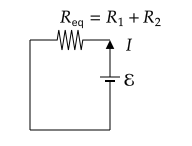
Reduce the following circuit as much as possible using equivalent resistances. Then, find .
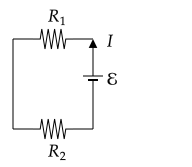
Answer: , where
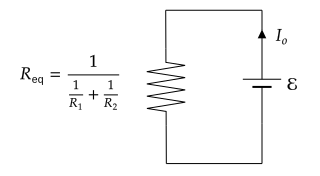
Reduce the following circuit as much as possible using equivalent resistances. Then find .
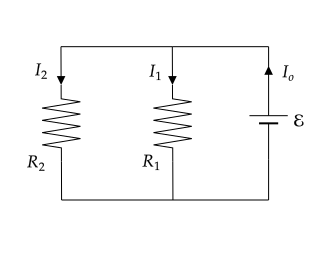
Answer: , .
Reduce the following circuit as much as possible using equivalent resistances. Then find .
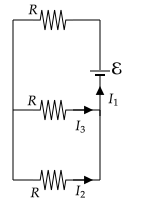
Answer:
The two lower resistors are in parallel and can be replaced with a resistor having an equivalent resistance of
The new circuit is
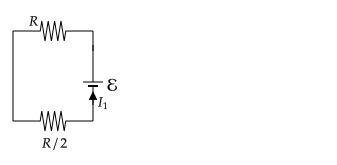
In the above circuit, the two resistors are in series and can be replaced with a resistor having an equivalent resistance of
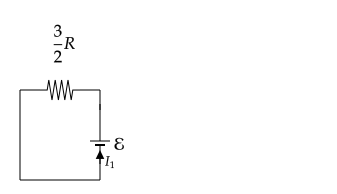
, where ; This is the same answer that was found for the identical circuit in the Kirchhoff’s law activity by solving three equations.
Reduce the following circuit as much as possible using equivalent resistances. Then find the equations for KCL and KVL that are needed to find the currents through and .
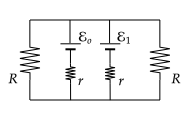
Partial Answer:
The two outer resistors are in parallel and can be replaced with a resistor having an equivalent resistance of .
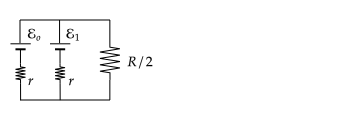
No further reduction is possible. At this point, we must use KCL and KVL to find the currents.
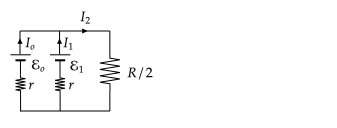
The currents can be found by solving
Find all of the currents in the circuit in Multiple Loops I.
The original circuit was:
We know the voltage across each resistor is , so we can write and .
Check: is satisfied because we found , where , so
.
Find all of the currents in the circuit in Multiple Loops II.
Answer:
In the following circuit, we know , so the voltage drop across the lower resistor is .
This voltage, , is also the voltage across the two lower resistors in the original circuit shown below.
So and (Note that the is expected.)
Check:
Find all of the currents in the circuit in Multiple Loops III.
Partial Solution: Once is known, so is the voltage across the two outer resistors: . So the current in the outer resistors, which have the same resistance , will be .