Gauss’s Law
Gauss’s law is derived from Coulomb’s law. Coulomb’s law can always be used to find the electric field due to a continuous charge distribution when the charge density is known. Gauss’s law is only useful for computing the electric field for certain continuous charge distributions. The list includes all of the charge distributions considered in the Enclosed Charge activity:
-
near the center of a long and uniformly charged line,
-
near the center of a long and uniformly charged cylindrical shell,
-
at any location for a uniformly charged spherical shell, and
-
near the center of a large and uniformly charged sheet.
Gauss’s law can also be used to find the electric field due to a long and uniformly charged solid cylinder and a uniformly charged solid sphere – the justification is that they can be created by nesting shells together, and the total electric field is the superposition of the electric field of each shell.
Gauss’s law states that the total electric flux through any closed surface is proportional to the total charge inside the surface.
In the following diagram, a closed spherical surface is shown. According to Gauss’s law, if we add all of the differential fluxes over a closed surface, the result will be . The surface does not need to be spherical – Gauss’s law is valid for any closed surface. Any imaginary surface that we use in Gauss’s law is referred to as a Gaussian surface.
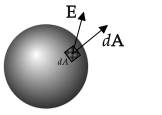
Gauss’s law can be used for computing the electric field due to a continuous charge distribution when the integral can be simplified. The required simplification occurs for a Gaussian surface on which the electric field is always
-
zero, parallel, or perpendicular and
-
if perpendicular, constant in magnitude.
There are two types of Gaussian surfaces that are used when Gauss’s law can be used to find the electric field. (In this activity, we only consider the first case.)
-
For a spherical Gaussian surface, Gauss’s law simplifies to , where is the area of a spherical shell with inside of it and is the radial electric field.
-
For a cylindrical Gaussian surface, we must consider three surfaces: the two end caps and the curved surface.
A spherical Gaussian surface of radius is centered on a point charge . Because the electric field due to a point charge is radial, the electric field will be perpendicular to the Gaussian surface for any , so
applies. The area of the surface of a sphere is , so
. Solving for gives
, which is what we expect from Coulomb’s law.
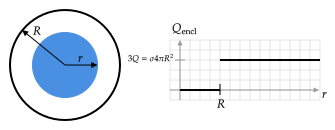
In the Enclosed Charge activity, a non–conducting spherical shell of radius with a charge of uniformly distributed on its surface was considered. Its cross–section is shown along with that of a Gaussian sphere of radius and the same center.
It was found that :
-
Why can we assume that if there is an electric field, it must be radial so that the electric field will always be perpendicular to the Gaussian surface?
-
Find
-
Plot
Answer
-
Pick a point in space at an arbitrary location to find the electric field. For any point, one can always find two charges on the shell whose electric field sum is radial. Given that one can construct a uniformly charged shell by placing such pairs of charges on a shell, the net electric field due to all charges on the shell must be radial. Draw a diagram to demonstrate this.
-
Because of our answer to 1., we can use
depends on , so our answer for must also depend on :
-
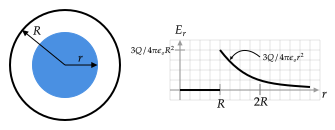
Notice that inside the uniformly charged shell, the electric field is zero. Outside, the electric field is the same as if all of the charge () was at the origin. This is a result that is often used when solving other problems and should be memorized.
(You may recall from mechanics that a similar result held – Newton showed that if mass is uniformly distributed on a spherical shell, the gravitational force on an object anywhere inside the shell is zero; outside the shell, the gravitational force is the same as if all of the mass is at the center of the shell.)
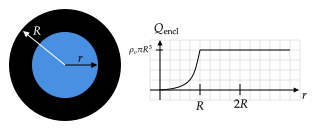
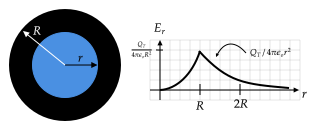
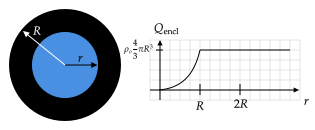
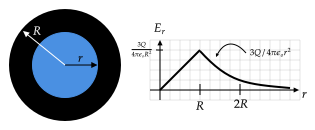
In the Enclosed Charge activity, a non–conducting sphere of radius with a charge of distributed uniformly throughout it was considered. Its cross–section is shown along with that of a Gaussian sphere of radius with the same center as the charged sphere.
It was found that
where
-
Why can we assume that if there is an electric field, it must be radial so that the electric field will always be perpendicular to the Gaussian surface?
-
Find
-
Plot
Suppose the charged sphere in the previous problem had a charge density that varied with radius according to .
-
Why can we assume that if there is an electric field, it must be radial so that the electric field will always be perpendicular to the Gaussian surface?
-
Find and plot .
-
Find
-
Plot