Magnetic Force and Torque
A wire carrying a current contains many moving charges. If a current–carrying wire is in a region of space with a magnetic field, the magnetic force on the moving charges in the wire results in a force on the wire.
Each charge moving with a velocity in a segment of wire will have a magnetic force on it of
For a straight segment of wire of length with the same on all parts of it, this equation can be transformed into an equation for the force on a straight segment with current :
or, equivalently, by defining a length vector with the same direction as and a magnitude of the length of the wire segment,
As was the case for the magnetic force equation for a charge , the magnitude of this cross–product can be written in a simplified form:
where is the angle between and and . The direction of the force is determined using the cross–product right–hand rule by crossing with .
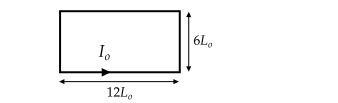
In the figure above, a magnetic field of magnitude is pointing out of the page, and the rectangle–shaped wire carries a current , has a height of , and a width of .
Determine the force on each side of the rectangle and the net force on the loop.
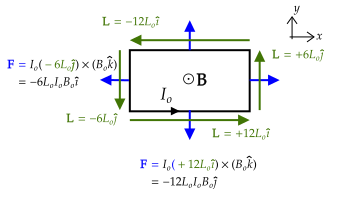
Answer: In this problem, a coordinate system was not given. We are free to use any coordinate system directions provided that it is a right–handed coordinate system. (In a right–handed coordinate system, . If we choose the direction to be to the right and up, then the direction must be out of the page in order for .)
-
Left segment: The length is and the current is flowing downward (in the direction), so and
Check: The direction of the force is consistent with that from using the right–hand rule for cross products (crossing with ). The magnitude of the force can also be found using . Using the given variables, . Here because and are perpendicular to each other. This leaves , which is the magnitude of found above using vector notation.
-
Right: The length is and the current is flowing upward (in the direction), so and
-
Bottom: .
-
Top: .
The sum of the forces is zero.
-
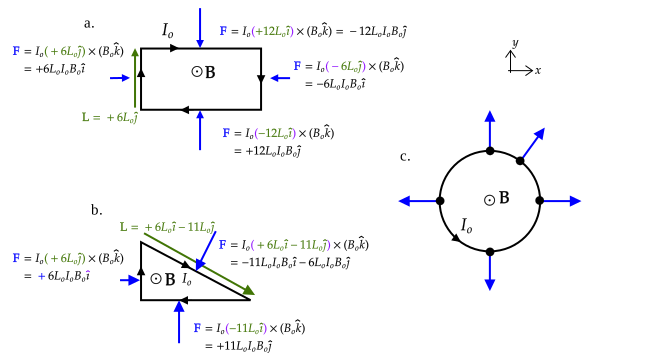
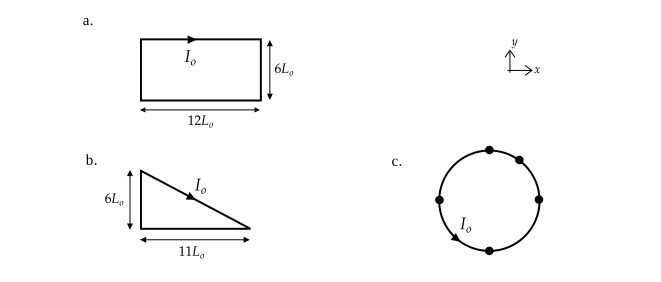
For the current loops in a. and b. in the figure above, determine the magnitude and direction of the force on each segment of the wire and the net force on the loop given that a magnetic field of magnitude points out of the page. Draw the force vector on the wire segments and show your calculation on the figure or in the space below.
-
For the current loop in c., determine only the direction of the force at each of the five points shown as solid dots when . Draw a vector on the diagram to indicate the direction of the force at that point. What is the net force on this loop?
In the previous section, you considered forces on the current loops when . The forces on all of the current loops that you drew should have been such that the loop would not tend to translate (the net force should have been zero).
The net torque on a closed loop in a constant magnetic field can be non–zero (in which case it will tend to rotate).
The torque on a current loop that lies in a plane is:
where is the magnetic moment defined as and is the area vector for a loop. The magnitude of the area vector is simply the area of the loop. The direction of the area vector is determined by a right–hand rule: wrap your fingers along the direction of the current and your thumb points in the direction of the area vector.
The equation predicts that when is perpendicular to , the torque magnitude is the largest. To see this, note that can be equivalently written as , where is the angle between and . When , the cross product will have the largest magnitude.
Interpreting the torque unit vector
-
A torque in the direction corresponds to a rotation in the same sense as rotation from the axis towards the axis;
-
a torque in the direction corresponds to a rotation in the same sense as rotation from the axis towards the axis;
-
a torque in the direction corresponds to a rotation in the same sense as rotation from the axis towards the axis.
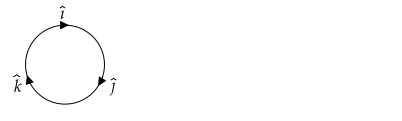
You do not need to memorize these – they can be obtained from the following diagram. Rotating towards gives (item 1. above). Rotating towards gives (item 2. above), etc.
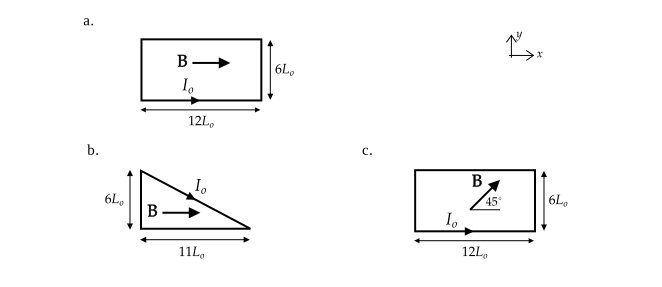
The three current loops are in a region of space with a constant magnetic field with a magnitude of .
-
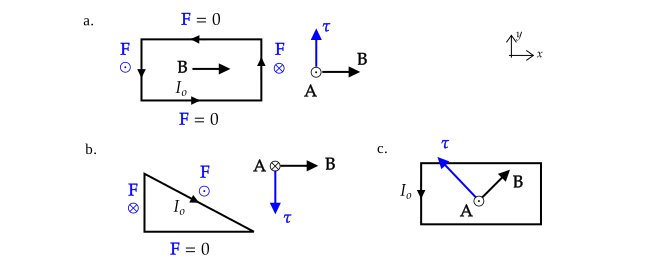
Will loop a. tend to rotate? If so, what axis will it tend to rotate about? Determine this by drawing the direction of the force (determined using the right–hand rule) on each segment of the wire.
-
If the current direction is reversed, will loop a. tend to rotate? If so, what axis will it tend to rotate about?
-
Will loop b. tend to rotate? If so, what axis will it tend to rotate about?
-
If the current direction is reversed, will loop b. tend to rotate? If so, what axis will it tend to rotate about?
-
What is the magnetic moment, , of loops a. and b.?
-
What is the torque, , on loops a. and b.? Verify that this torque vector corresponds to an axis of rotation that matches your previous answers.
-
For loop c., compute when and verify that this torque vector matches what you would expect from using the right-hand rule to determine the direction of the force on each segment of the loop.
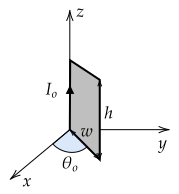
If ,
-
Find the force on each segment of the loop.
-
Find the net force on the loop.
-
Find the net torque on the loop.