Previously, you have calculated the electric field due to a collection of point charges. From superposition, the electric field at any point in space is the sum of the electric field due to all point charges.
Suppose that you wanted to know the electric field created by a plastic rod that was positively charged by rubbing it against fabric. The number of charges that you would need to account for is on the order of . If you could do one calculation per second, computing the electric field due to each of the charges would take longer than the time since the Big Bang.
To allow for an answer in a finite amount of time, the approximation that charge is uniformly distributed along a line can be made. Consider charges placed on a line as shown on the left-hand side of the diagram below. To compute the electric field at the open circle, we would need to compute the electric field due to each of the nine charges there. Instead, we will make the approximation that the charges are smeared out onto the line to form a continuous charge density.

Mathematically, we are converting a sum to an integral. The electric field at the open circle is
In the notation of Griffiths, is the position of the point of interest, and is the position of a charge, so

As a sum, this is
Smearing the to give a continuous charge density over all differential elements allows us to write
where is the line. The accuracy of the integral approximation increases with .
The arguments given above do not depend on the fact that the charges are on a line, and so the can be dropped, and can be replaced with . In addition, by convention, the approximation symbol is replaced with an equality symbol, giving
where represents a differential charge on a diffential line, area, or volume element.
The advantage of using the integral approximation is that to get an answer; we only need to solve an integral – we do not need to compute electric field contribution for each point charge and then do a vector sum.
To emphasize the fact that the result of the integration depends on the unprimed variable , and that the result of integration should not have any primed variables, we sometimes explicitly include the dependence of on :
In the case where was written with cartesian coordinates, this would be
To simplify notation, we often use the definition
for the integrand, which corresponds to the electric field at due to a differential charge at .
depends on primed coordinates and so for clarity it would be better written as , or . However, this is not the convention.
When integrating, the , , and (or unprimed cylindrical or spherical coordinates) that appear in should be treated as constants during integration because they do not depend on the primed dummy integration variable. As an example, consider the integral
The result of integration will not depend on because is “integrated over”. The result of the integration
does not depend on .
More generally, starting with
replace with so that we have a differential electric field due to do a differential charge
Next make the assumption that a point charge is continuously distributed over a small volume. In this case . The functional dependence of has been added because the amount of charge in a given small volume may depend on the location of the small volume. Substitution of and integration gives
An approximation () sign was used to remind us that technically this equation is an approximation because we smeared point charges so that they are uniformly distributed in a volume. Usually, we replace the with because for a large enough density, the result from integration is very nearly that from the exact expression
Introductory physics textbooks often give examples of finding the electric field due to a continuous charge distribution for which there is a short-cut solution (e.g., a ring or disk of charge). However, most continuous charge distribution problems do not have a short-cut solution. Griffiths gives only one example (Example 2.2) on computing the electric field using a general method.
In this section, I provide steps that can be used to find the electric field for an arbitrary continuous charge distribution using Example 2.2 as an example for the steps. Part of the method of solution shown here will be needed later when computing dipole approximations; the steps for computing the electric potential, , due to a continuous charge distribution and the magnetic field, , due to a current system will also be similar (in the case of currents, the Biot-Savart equation is used instead of Coulomb’s Law).
Based on the problem statement and diagram, write down features that you expect your solution to have. These statements should have the form
-
“For large , the solution should approach that for the case where all charge on line/sheet, etc. is at the origin.”
-
“For small , the solution should approach that for an infinite sheet of charge.”
-
“The computed electric field should have only a -component.”
Such statements can be used to check your final answer and also intermediate steps.
A line of charge from to with a uniform charge density . We can make several statements about the electric field on the –axis.
-
should only have a –component due to cancellation symmetry.
-
For (far away from the line), one expects an answer that approaches the answer for a problem where all of the charges on the line are placed at the origin. In this case, the basic form of Coulomb’s Law for the electric field due to a charge at the origin can be used to find the answer in terms of the parameters given: and is in the direction for and in the direction for .
-
For , one expects an answer that approaches the answer for an infinite line of charge (an ant placed near the origin will conclude that the charges extend to infinity in both directions). In this case, one can look up the equation for the electric field due to an infinite line of charge (or use Gauss’ Law to find it).
A circular ring of radius in the – plane and centered on the origin has a charge density .
Write at least two predictions about the electric field on the –axis due to the ring.
The differential charge must be written in terms of a coordinate system prior to integration.
-
For charges on a line,
-
For charges on a surface,
-
For charges in a volume,
In this step, the general differentials , , or are written in terms of a coordinate system (usually cartesian, cylindrical, or spherical). The choice of coordinate system depends on the problem; usually, the coordinate system that is “best” will be somewhat obvious (“best” is used in the sense that it makes the integration easiest).
Note that when writen with a coordinate variable (e.g., instead of the generic variable ), the differential element is written with a prime. The reason is that the position of the charges that cause the electric field is by convention written with a prime, and we want to integrate over the position of the charges. Ideally, we would use , , , and to emphasize this, but this is not the convention.
For a line of charge with charge density over , find in cartesian coordinates.
Answer
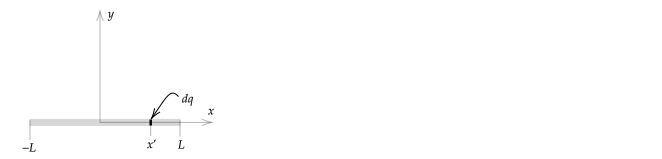
If the differential charges lie on the –axis, then . So the electric field due to can now be written by replacing with . If depends on , we should write to emphasize the fact that the charge on a differential element depends on .
Find for charges with a uniform density
-
a differential charge on the line and
-
a differential charge on the curve , where is a constant.
Answer
From Charge Densities,
1. (That is inflated by should be clear from the diagram used to derive the relationship between and .) Prior to use in integration we will need to replace with .
2. . Prior to use in integration we will need to replace with and with .
Write an equation for in spherical coordinates for a uniform charge on
-
a circle of radius centered on the origin and in the – plane; and
-
the same circle when shifted along the –axis by .
First, write the full definition of and using cartesian unit vectors.
The point where we want to compute the field is .
The position of a differential charge that contributes to the field at is .
Both and can be written in any coordinate system, but in general cartesian unit vectors should be used.
Next, simplify and based on the problem statement. For example, if the problem is to compute the electric field on the –axis, then . If all charges are on the –axis, then .
Finally, insert the reduced and into
For a line of charge with charge density over , find for a point on the –axis.
Answer
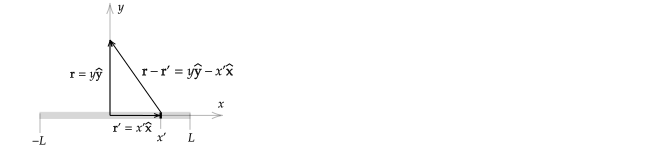
The point of interest has and so
If the differential charges are all on the –axis, then and . We can now write
Common Errors
1. Not having a primed variable in the equation for . In the next step, suggestions are given that will allow you to catch this type of error.
2. Miscalculation of the magnitude, which is
If this does not make sense, make sure to review Vectors and the following. In general, will have the form
so that
where and depend on the problem. In the example given here, and .
3. Wrong signs in the calculation of – the negative sign applies to all of the components of .
For example, if
and
then the error is to write
instead of
This correct version simplifies to
Write an equation for in cylindrical coordinates with cartesian unit vectors for a point of interest on the –axis for charges on a circle of radius centered on the origin and in the – plane.
Answer:
, (draw a diagram to check this!)
Note that I have used instead of in this equation and for the differential. Because there is no in , I could use . However, it is better to use so there will not be confusion for a problem where there is an in .
Write an equation for in spherical coordinates with cartesian unit vectors for a point of interest on the –axis and charges on
-
a circle of radius centered on the origin and in the – plane; and
-
the same circle when shifted along the –axis by .
Recall that the integral to be solved is
and the notation for the integrand of
At this point, you have and in terms of coordinate system variables. (Don’t forget to write the coordinates in with primes.) The integrand is the electric field at any point due to a charge at .
To check , plug in a few values of and and verify that the resulting is consistent the expected result.
For a line of charge with charge density over and for a point on the –axis, and
Provide three checks of this equation.
Answer:
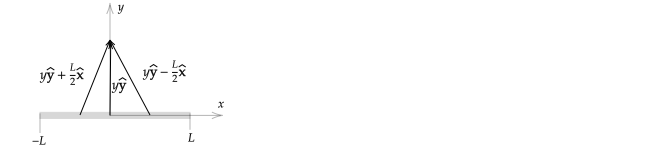
1. Plug in , , and and verify that the direction is as expected for . In the following diagram, a vector for the numerator of is shown. These vectors point in the direction expected if there is a charge at their tails. If we scaled the vectors draw by the denominator in , the vector in the center will be shorter, which is expected because the at its tail is closer to the point of interest.
The above could be repeated by plugging in values of , in which case all of the vectors should point downwards.
2. We expect that as increases, the angle with respect to the –axis should decrease. This statement is consistent with the equation for because for fixed , the term becomes much larger than the term as increases.
3. For , we expect to be that for a point charge at the origin. Plugging in gives . This has the expected magnitude and direction for and .
For a point of interest on the –axis and due to a uniform charge density of on a circle of radius centered on the origin and in the – plane, and and so
Provide at least two checks of this equation. Include a diagram.
The most frequent type of symmetry will be cancelation symmetry, where pairs of differential charges create an electric field at a point with a component that cancels.
For a line of charge with constant charge density over and for a point on the –axis,
Identify symmetries that can be used to simplify the problem.
Answer
Vectors for and are shown for to points on the line that are equidistant from the origin in the following figure. The quantity of differential charge for both cases is equal to .
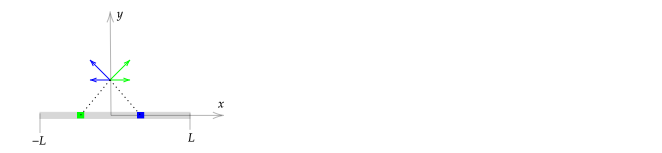
Because the horizontal components cancel, we conclude that the horizontal component of the will end up to be zero after integration.
A mathematical way of stating this is , so integration of over will be zero.
(If is not constant, for example it is , then differential charges on the left side of the line have less charge and so there are no cancelling pairs as was the case for the previous example. In this case, the left–most is and the right–most is .)
for a point of interest on the –axis and due to a uniform charge density on a circle centered on the origin and in the – plane is
Simplify this equation using a symmetry argument. Include a diagram.
There are two possibilities:
-
The integral can be solved “exactly”, which informally means standard methods can be used to do the integration, e.g., using trig substitutions, an integral table, or entering the integral into Mathematica or WolframAlpha. The technical term is a “closed–form” solution. An example of an integral with a closed–form solution is .
-
The solution of the integral can only be expressed as an infinite series. An example is the elliptic integral of the first kind:
.
We will encounter such integrals later in the semester – they also appear in classical mechanics.
In these cases, one can convert the integrand to a polynomial using a Taylor Series or related expansion prior to integration. This will be covered in detail later in the semester when electric and magnetic dipoles are covered. The basic procedure is to re-write the integrand as an infinite series, e.g.,
where the constants are determined using the Taylor Series expansion formula (or related method for expanding a function). Written in this way, the integral only involves the integration of polynomials. There are subtleties to this method – one needs to ensure that the series is converging; sometimes, several approximations to are needed, one for locations near the charge distribution and one at far locations. These issues will be considered in detail later in the semester.
For a line of charge with uniform charge density over , find , the electric field at a point on the –axis.
Answer:
Previously, it was found that
so
The constants, cartesian unit vectors, and have been factored out of the integral because they do not depend on the dummy integration variable .
Based on arguments given earlier, the second integral will be zero. This leaves
(On exams, you will only be asked to set up the integral.) The integral can be evaluated using a trig substitution, and the result is
Because is the total charge on the line, the answer can also be written in terms of the total charge on the line, , as
Suppose that we were not able to integrate
To demonstrate the method that applies when we there is not a closed–form solution to the integral, here we will expand the integrand assuming that and . First, factor out from the square root and also from the integral (it does not depend on )
The integrand has the form , where and . The maximum value of is , which is small based on assumtion. We can thus write
Integrating the first two terms gives
If only the first term in parenthesis is kept, the result is the same as that for a charge at the origin, which was a prediction made prior to solving the problem. Does it make sense physically that the “correction” to the term that corresponds to all of the charges at the origin is negative and the same for positive and negative ?
The electric field on the –axis due to a uniform charge density on a circle of radius centered on the origin and in the – plane is
Find an exact solution to this integral.
The final step is to check the predictions made prior to starting the problem.
For a line of charge with uniform charge density over , , the electric field at a point on the –axis is
Check the predictions made previously about the answer, which were
-
should only have a –component due to cancellation symmetry.
-
For (far away from the line), one expects an answer that approaches the answer for a problem where all of the charges on the line are placed at the origin. In this case, the basic form of Coulomb’s Law for electric fields can be used to find the answer in terms of the parameters given and is in the direction for and in the direction for .
-
For , one expects an answer that approaches the answer for an infinite line of charge (an ant placed near the origin will conclude that the charges extend to infinity in both directions). In this case, one can look up the equation for the electric field due to an infinite line of charge (or use Gauss’ Law to find it).
Answer:
-
This is clearly true.
-
To address , we can factor out from the square root to arrive at
When , the square root term is nearly unity. And the result is when and when .
-
To address , we can first factor out from the square root to arrive at
When , the square root term is nearly unity, leaving . The electric field for a line of charge is usually given in cylindrical coordinates as . When , and ; when , and and so the prediction is correct.
Check the exact answer found previously for the electric field on the –axis due to a uniform charge density on a circle of radius centered on the origin and in the – plane.
A line of charge with uniform charge density of extends from to on the -axis, where .
Follow and show the steps given in the notes and find on the –axis for in terms of one or more of and cartesian coordinates and unit vectors.
Answer:
Students who had difficulty with this problem typically did not follow the steps outlined in the notes. The motivation for the steps is that they help students who have difficulty with these types of problems.
The steps are
-
Identify Answer Features
-
Find , , or
-
Find
-
Check
-
Simplify using Symmetry Arguments
-
Integrate
-
Check Answer
1. Identify Answer Features
We are asked for the field on the –axis. For , the line of charge looks like a point charge near the origin, so we expect . We also expect that as , the field should become large.
2. Find , , or
The charges are distributed on a line, so we need . In this case, because the charges are on the –axis.
3. Find
and
and
We are asked for the field for . In this case, (the point of interest is always to the right of a differential charge), so and we can write
4. Check
Where from step 2. and
from step 3. Thus,
This corresponds to the equation one would write for a point charge at at a location . If , the field becomes that for at the origin, as expected.
6. Integrate
and do not depend on , so they can be factored out of the integral.
Many students who did not follow the steps wrote an upper limit of , possibly because they were basing their solution on a textbook solution for an infinite line of charge.
Integration gives
Simplifying gives
7. Check Answer
When , approaches .
As , becomes large.
A line of charge with a uniform charge density of extends from to on the -axis, wh
Follow and show the steps given in the notes and find on the –axis in terms of one or more of and cartesian unit vectors.
Partial Answer:
Step 1 (Expected answer features)
-
–component should always be negative; component should be for and for .
-
For , .
-
As , .
Steps 2. – 4. are the same as example given above for due to a line of charge on the –axis.
In this problem, the limits of integration are different: they extend from to . We need to evaluate
This can be written as two integrals:
Using WolframAlpha (first integral; second integral),
Repeat the previous two problems when the line of charge is shifted in the –direction by .
A line of charge in the - plane has a uniform charge density of , passes through the origin, is at an angle of with the -axis, and extends from to .
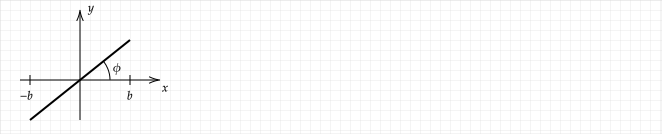
Find on the –axis using two two methods:
-
Find on the –axis by following the steps in the notes.
-
Check your answer for small by transforming the equation for given in the notes for a line of charge on the –axis between and to coordinate system rotated by about the –axis.
Partial Answer:
This is a line of charge, so the general relationship is .
In general, a differential element parallel to a line in the plane can be written as
the magnitude of is
factoring out gives a formula that may be familiar from a calculus course in which the the length of a curve is computed:
In this problem, we are not explicitly given , but it can be derived by noting from a diagram that so that
and so . Substitution gives
and finally an equation for
In general,
and
For this problem, we only want to know for points on the -axis, so and leaving
the line of charge is in the - plane, so is always zero, leaving
Write
replacing with the differential found in Step 1, , and using the reduced versions of and in Step 2. Noting that
which can be rewritten as
The magnitude is
and substitution gives
The final step is to integrate this equation from to :
was found in terms of , so all of the primed variables need to be written in terms of . Using gives an equation that is ready for integration
To solve this, start by factoring out the constant terms
and write the equation in terms of two integrals with and treated as a constant with respect to the integration. In terms of these integrals, is
where
As , we expect the field to be perpendicular to the line and to be related to the field along a line perpendicular to it. One can use the equation for for a line of charge along the –axis from and re–name as , with the perpendicular distance from the rotated line. In this case, and are related by .
To finish the problem, integrate and let . You should find that becomes perpendicular to the line as . Setting should give a match to the equation for .
Charge is uniformly distributed along the line from to .
Find an equation for on the –axis in terms of an integral with an integrand that depend only on , , , and . You do not need to evaluate the integral.
A uniformly charged circle of radius with a total charge is in the – plane and centered on the origin.
Find an equation for (the field at any location in space) in terms of three integrals with integrands that depend only on , , , , and , and . You do not need to evaluate the integral.
A uniformly charged disk of radius with a total charge is in the – plane and centered on the origin.
Follow and show the steps given in the notes and find on the –axis in terms of one or more of , and cartesian unit vectors.
Answer:
Comments:
-
This is an example commonly given in intro physics textbooks and it has a short–cut solution. Some students essentially gave a few equations from the example solution without justification. I asked you to follow the steps given in the notes because the method used in the example solutions won’t help you on more complicated problems. So make sure that you know how to solve this problem using the steps in the notes.
-
Many students came up with an that had the wrong sign. I took off points for this because the sign error would have been obvious if you had checked your answer to verify that had a positive component when .π
1. Identify Answer Features
(a) We expect that for , to aproach that of an infinite sheet of charge, for which is perpendicular to the sheet and points away from it. For this problem, this means with the above the sheet () and below the sheet ().
(b) For , we expect with the sign the same as that of .
2. Find
The differential charge can be written in cylindrical coordinates as .
3. Find
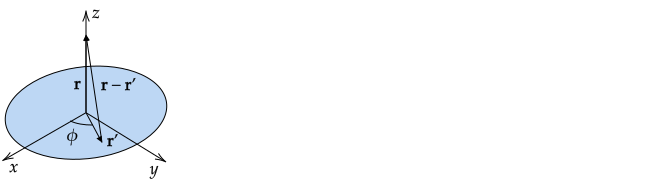
In general,
The point of interest is constrained to be on the –axis, for which , so
In general,
and the location of the charge acting on the point of interest has , and so
Given that was written in cylindrical coordinates, we should write using the same coordinate system:
Note that is used in this equation makes depend on the radial distance of the charge . In the ring problem, is used instead of .
4. Check
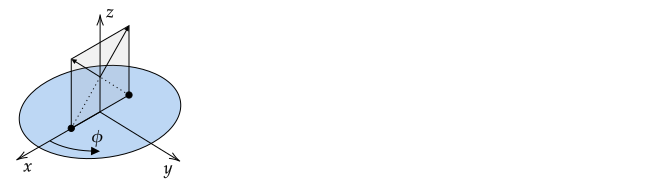
When , has a component and no component. This is consistent with the following sketch.
If , then the term dominates and is , so a charge at any produces a field at large that is near that if it were at the origin.
5. Simplifying using Symmetry Arguments
We want to integrate, so need to write in terms of coordinates. On the disk, a small patch has an area of , so
This gives
Based on the symmetry argument that we can always find another that exactly cancels the horizontal component of a given , we expect the and terms to be zero, so we can drop them. Or we can notice that after factoring out everything that does not depend on , the integrals for the and terms are and from to , which are both zero. Note that if a 1/2 disk was given, the integral limits would be from to , and one of the integrals would not be zero.
6. Integrating
Factoring out the constants gives
Nothing in the integrand depends on , so the integral reduces to
The result of the integration gives the final answer (to integrate, use a substitution of and use ).
7. Checking Answer
From step 1, we expect that
(a) We expect that for , to aproach that of an infinite sheet of charge, for which is perpendicular to the sheet and points away from it. For this problem, this means with the above the sheet () and below the sheet ().
(b) For , we expect with the sign the same as that of .
(a) For , only the first term in parenthesis is large
Notice how the term tells use the direction of the electric field. When , this term is . When , this term is .
(b) For , we need to do a bit more work on the second term in parentheses in (3). Factor out a from the square root to get
Because , we can use the binomial expansion to get
Simplifying gives
To show that in this limit the result is the same as if all of the charge was at the origin, we need to compute the charge on the disk, which is
Substituing for gives
Charge is uniformly distributed on the curved surface of a cylinder of length and radius . The cylinder is centered on the origin, aligned with the –axis, and has a charge density of .
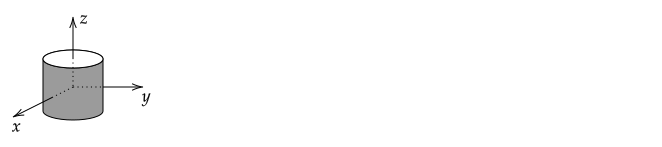
Find an equation for on the –axis in terms of a single integral with an integrand that depends only on , , , and . You do not need to evaluate the integral.