The electric potential due to a “pure” electric dipole centered on the origin is
and the electric field is
(Griffiths defines a “pure” dipole on page 159; when , where is the separation distance between the charges, the field of the dipole approaches being purely due to the term in the expansion of the potential due to the two charges.)
If the dipole is not at the origin, then we need to replace with and with . Then the electric potential and field at due to an electric dipole with its center at is
and the electric field is
If the dipoles can be considered as being continuously distributed, then the differential potential, , due to a differential dipole, is
If we define an electric dipole density according to
then
and the total potential at a point is
A corresponding equation for could also be derived. However, it is usually easier to compute by first computing .
A solid cylinder of radius and height is aligned with the -axis, centered on the origin, and has a polarization .
-
Compute the potential on the –axis using
-
Show that the result for is idential to the equation for potential for two disks centerd on with .
Answer
1.
Substitution and integration over gives
Using
Gives
and
-
These two integrals are the same as the integrals one would obtain for computing for the two disks. In this case, the starting equation would be . For both disks, and . For the top/bottom disk, so .
The equation
can be written as
where the closed integral is taken over the closed surface of volume and
(with evaluated on the surface.)
and
.
A partial proof is given in the Appendix.
Recall that for regular (non–bound) charges on a surface or in a volume, the equation for is
This has the same form as the new equation
The implication is that we can use the same techniques used to find or created by charge densities and for problems with and . If we encounter a problem where and (1) are on the same surfaces and (2) have the same spatial dependence as and in a problem solved previously, we can use the previous solution with the replacement of with and with .
A solid cylinder of radius and height is aligned with the -axis, centered on the origin, and has a polarization .
-
Compute and .
-
Compute
Answer
This problem was solved earlier using the formula
Here it is solved using the alternative form for that involves bound charge densities.
can be shown by direct calculation using the divergence formula in either cartesian or cylindrical coordinates. Using , on the top/bottom caps so . On the side surface, , so .
To find the electric field, we could compute the potential using
and then compute . Or, we can simply use the equation for the electric field on the –axis due to a uniformly charged disk found previously:
This equation is for a uniformly charged disk in the – plane and centered on the origin. The field due to on the top surface is this equation with the replacement of with and with . The field due to on the bottom surface is this equation with the replacement of with and with . The total field is the sum of these two fields.
In 4.2 of Griffiths, he models a polarized sphere by using two uniformly charged spheres with centers that are separated by a small distance . One sphere has a postive charge and the other a negative charge. He then computes the electric field in the overlap region and in the region outside of both spheres where there is no overlap.
In this problem, a polarized slab will be modeled using two slabs of charge with uniform and opposite charge density that are offset by a small distance .
-
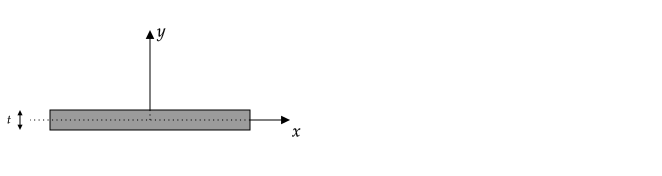
Find for the slab with uniform charge density shown in the following figure. Assume that the slab is infinite in extent in the and directions so that Gauss’s law can be used. (This slab can be thought of as being composed of thin sheets of charge stacked together and so an alternative to using Gauss’s law is to sum the electric field due to sheets of charge.)
-
Plot vs .
-
Next, compute and plot for the same slab if it had charge density of and was shifted by in the –direction. Assume that .
-
Compute in the region of overlap of the and slabs.
Answer
Details on how to solve this problem were given in class and so only a summary is given here.
1. Gauss’s law can be used to find the field for (a cylinder centered on the origin or with its bottom cap at can both be used). This gives above/below the slab. Inside the slab, we know at because the field due to the upper part of the slab cancels that due to the lower part. We also expect that inside the slab, field will increase linearly (why?). From this, we can write . This equation gives zero at the origin and matches the outer field at . Alternatively, we can also use Gauss’s law. For a cylinder centered on the origin and height , the charge enclosed is .
2.
3. Invert the plot from 2. and then translate it by in the direction. Inside the negatively charged slab, the field will be . (This gives when , corresponding to the center of the negatively charged slab.)
4. In the region of overlap we need to sum
Using and gives
This is the same field one would get if we had a positive sheet of charge at and a negative sheet at if the sheets had a charge density of . If one draws the charge density when the two slabs are superimposed, the system appears to be two such sheets of charge.
in the region on a slab that is infinite in the and directions.
-
Find and
-
Find
Answer
On the top surface, (because ) and on the bottom surface, (because ). The bound volume charge density is .
To find due to this polarized slab, we need to find created by two infinite sheets of charge that are parallel with to the – plane. The sheets have and are at . This problem has been considered before and the result is between the sheets and zero outside. Therefore, betwen the sheets and outside. See also HW #8 where a polarized slab was created by superimposing two slabs of charge density and then shifting one down by a small distance.
Follow–up Questions
-
Is this direction of expected for ? Base your answer on the fact that represents dipoles oriented in the direction within a small volume.
-
The net polarization charge is zero. Is this expected?
-
What is the field if two of these slabs are stacked together to form a slab of thickness ?
A long solid cylinder of radius has a polarization . The cylinder is centered on the origin an aligned with the –axis.
-
Find and .
-
Find for small , which is the electric field due to the bound charge densities found in part 1. of this problem.
A solid cylinder of radius and height is aligned with the -axis and has a polarization .
-
Find and .
-
Compute the total bound charge.
-
Sketch the field lines inside and outside of the cylinder when .
-
Sketch the field lines inside and outside of the cylinder when .
![https://i.stack.imgur.com/YJXXP.gif]](https://i.stack.imgur.com/YJXXP.gif%5D)
A solid sphere of radius has a polarization . The sphere is centered on the origin.
-
Find and .
-
Find , which is the electric field due to the bound charge densities found in part 1. of this problem.
-
Sketch the field lines inside and outside of the sphere.
A sphere of radius has a spherical cavity of radius . The sphere and cavity are centered on the origin. The region has a polarization .
-
Find and .
-
Find , which is the electric field due to the bound charge densities found in part 1. of this problem.
Answer
-
at and at . .
A common error is to write in terms of . Remember that the equation for is evaluated on the surface. In this problem, the surface is at either or .
-
One can use Gauss’s law with the above charge densities to find: for and and , where .
It is easier to use Gauss’s law for dielectrics. Inside the sphere, there is no free charge, so . From symmetry arguments (what are they?), we can write and so the integral reduces to for all . Using the definition of with for and gives in these regions. at from a symmetry argument (what is it?). Inside the sphere, is non–zero and as before.
A sphere centered on the origin has a polarization of .
-
Find and .
-
Compute the total bound charge.
-
Sketch the field lines inside and outside of the sphere.
-
Repeat this problem assuming the sphere has an empty center out to a radius .
Answer
, so
, which can be obtained from a diagram or by writing and using . Or, one can derive explicit formula for in spherical using a diagram: .
Bound charges on sphere are largest at the poles with the top pole being positively charged. Field lines are dipolar outside. Inside then are generally pointing downward (exact result is that they point straight down inside).
Integrating over surface gives net bound charge of zero (as expected).
With hole in center, need to account for a new surface at , which has .
A long cylinder of inner radius and outer radius has a polarization . The cylinder is centered on the origin an aligned with the –axis.
-
Find and .
-
Find for small , which is the electric field due to the bound charge densities found in part 1. of this problem.
A sphere of radius has a spherical cavity of radius . The sphere and cavity are centered on the origin. The region has a polarization .
-
Find and .
-
Find , which is the electric field due to the bound charge densities found in part 1. of this problem.
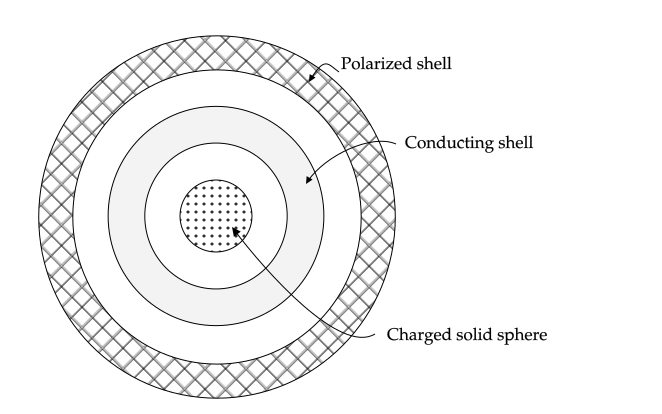
The following figure shows a cross section of three spherical objects.
-
For the charged solid sphere within ,
-
The net charge on the conducting shell is . This shell has an inner radius of and an outer radius of .
-
The (“frozen in”) polarization of the polarized outer shell is . This shell has an inner radius of and an outer radius of .
-
Find
-
Find the potential difference between the charged solid sphere and the inner surface of the conductor (that is, find ).
% For $3R\le r\lt 4R$, $Q_{encl}=0$, so $E_r(r)=0$ % % For $r \gt 4R$, the field due to the charges on the conductor and solid sphere is zero. % % At $r=4R$, $\sigma_{bi}=-P_o/(4\pi (4R)^2)$, so $Q_{bi}=\sigma_{bi} 4\pi (4R)^2 = -P_o R^2$ % % $\rho_b=0$ inside polarized object. %
% Inside the polarized object, $E_{b\text{ }r}(r)=kQ_{b\text{ }encl}/r^2 = kQ_{bi}/r^2 = -kP_oR^2/r^2$ %
% At $r=5R$, $\sigma_b=P_o/(4\pi (5R)^2)$ so $Q_{bo} = P_oR^2$. % % Outside the polarized object, $Q_{b\text{ }encl}=Q_{bi}+Q_{bo}=0$, so $E_{b\text{ }r}(r)=0$. %
% The total field for $r\gt 4R$ is the field due to the bound charges and the field due to the other charges. The field due to the other charges is zero, so the field is only due to the bound charges. %
% For $4R\lt r\lt 5R$, $E_r(r)=-kP_oR^2/r^2$ %
% For $r\gt 5R$, $E_r(r)=0$
%
%2. $V(2R)-V(R)=-\int_{R}^{2R}E_r(r)dr=-kQ/2R$. Could also use point charge formula $V=kQ/r$ because field is equivalent to that of a point charge $Q$ at the origin, so $V(2R)-V(R)=kQ\left(1/2R-1/R\right)=-kQ/2R$.
A cube with side length and centered on the origin has a polarization .
Find the bound charge densities.
A cube with side length and centered on the origin has a polarization .
Find the bound charge densities.
A square of side lies in the – plane, is centered on the origin, and has sides parallel to the coordinate axes.
The square has a polarization of .
Find the electric field.
A disk of radius lies in the – plane, is centered on the origin, and has a polarization
Find the electric field.
Consider a point far enough away that dipole term dominates.
Assume a dipole volume density of
where is the average dipole moment in the small volume
For a single “perfect” (or “pure” or “ideal”) dipole at the origin
For a “perfect” dipole at , make the replacements and
Using , the potential at due to the differential volume
where now means the location of the differential volume . For , ; summing over all in gives
Using
this can be written as
It is important to remember that we assumed was outside of the volume of integration and that the dipoles are perfect. It can be shown that this same equation applies to points inside the volume and when the dipoles are not perfect (See Zangwell or Griffiths; Jackson also addresses in Chapter 4.1, but does not mention in derivation similar to the above that appears in Chapter 4.3).
Integration by parts (or the identity )
The first term can be rewritten using the divergence theorem
Compare this equation with the equation for the potential due to a charge density and surface charge density
from which it followed that
If we define “bound” densities and
In addition, one can compute the electric field, , due to the bound charge density using .
At this point, we have essentially considered a system of two types of charges: single charges, represented by and pure dipoles, represented by . There is a class of problems one can solve where you are given a fixed (or “frozen-in”) and are asked to find . In this case, one simply computes and and integrates to find . Quite often, one does not even need to do an integration - if we know the potential for an ordinary charge distribution (or ) and we find (or ) has the same distribution, we only need to replace (or ) with the value of (or ) in terms of .
See the description for [[#Magnetized_Objects]] for a way of thinking about how an object gets polarized. The main difference is that an electric field causes the random dipoles to become aligned anti-parallel to an external electric field. If the object is somehow “frozen” so the non-random dipoles can’t randomize after the external field is turned off, you get a polarized object. Most materials are such that the induced polarization electric field tends to oppose the external electric field (dielectrics). In contrast to magnetizable objects which can enhance (paramagnets) or oppose (diamagnets) the external magnetic field.
The mnemonic I mention in class for the prefix is that “di” or “dia” means the object wants to “die” (kill) the external field. (From a language perspective, dielectrics should be called diaelectrics since dia in Greek is “oppose”, but Faraday decided it did not look right and so used “di”. If you happened to know the prefix “di” means double in Greek, you would be a bit upset about this decision; perhaps he should have used “un-di-electrics” …).