In sections 2. and 3. an introduction to electric potential difference, is given using the notation used in PHYS 260 and using problems at that level.
In section 4., is derived based on vector field concepts following the notation of Griffiths.
The chapter on potential in your PHYS 260 textbook and Griffiths 2.3 and 2.4 are recommended as references. An additional reference is guide03.pdf.
The potential energy of an object increases when you do a positive amount of work on it. For example, if you lift a mass from the floor, you increase its potential energy. The work done on an object changes its potential energy, and this change is represented by .
Mathematically, the work done by a force in moving an object from position to position along a line is
and this work changes the potential energy of an object according to
where the symbol is used to indicate that is defined to be the final potential at minus the initial potential at .
If a force is always perpendicular to the direction of movement, the work due to that force is zero.
When the force on an object does not change when it is moved a distance from to along a straight line, and the force vector is aligned with the path of movement, then
where is positive; the sign is used for a force that is in the direction of movement and the sign is used for a force that is in the opposite direction of movement. (You should know how to derive this.) For example, if you lift a mass upwards by a distance , the force you exert is in the same direction of movement, so you do a work of . The gravitational force on the mass is in the opposite direction of movement, so the work done by the gravitational force is .
One of the most common difficulties in calculating work and energy is getting the correct sign for the answer. The following two problems have questions that ensure that you are able to predict the correct sign of work and changes in potential energy.
The following diagram shows a region of space where the electric field is constant and has a value of N/C.
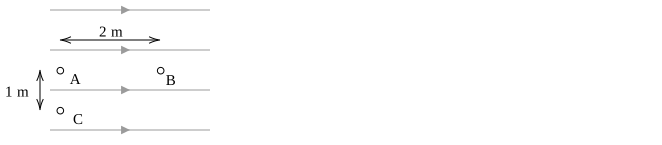
1. You place a charge of C at point . What happens to that charge when it is released?
2. You move a charge of C from to . (a) How much work did you do? (b) How much work was done by the electric field? (c) By how much has the potential energy of the charge changed?
3. You place a charge of C at point . What happens to that charge when it is released?
4. A charge of C is moved from to . How much work did you do? (b) How much work was done by the electric field? (c) By how much has the potential energy of the charge changed?
5. You move a charge of C straight downward from to . (a) How much work did you do? (b) How much work was done by the electric field? (c) By how much has the potential energy of the charge changed?
6. If you move a charge of C from to but deviate from a straight line, will your answers to the previous problem change? If no, explain why. If yes, provide new answers.
In the previous problem, a charge was moved in a region of space where the electric field was constant and so the calculation of work did not require integration. In this problem, the electric field is not constant and so the calculation of work requires integration.

There is a charge of C at the origin. Some electric field lines for this charge are shown. To simplify the math, use .
1. You move a charge of from to . (a) How much work did you do? (b) How much work was done by the electric field? (c) By how much has the potential energy of the moved charge changed?
2. You move a charge of C from to . (a) How much work did you do? (b) How much work was done by the electric field? (c) By how much has the potential energy of the moved charge changed?
3. You move a charge of C from to along the dotted line. (a) How much work did you do? (b) How much work was done by the electric field? (c) By how much has the potential energy of the moved charge changed?
4. You move a charge of C from to but deviate from the dotted line. (a) How much work did you do? (b) How much work was done by the electric field? (c) By how much has the potential energy of the moved charge changed?
In the previous section, we considered moving an arbitrary amount of charge (either positive or negative) from point to point and computed its change in potential energy .
An electric potential difference is defined to be the change in electric potential energy of a (positive by convention) test charge when it is moved from point to point divided by the magnitude of the test charge.
As a result, the only difference between the calculations performed previously and calculations is that we first compute for a C charge. To get , we simply divide by by C.
The definition of electric potential is similar to the definition of electric field in that they both involve the consideration of a test charge. That is, the electric field is the force on a test charge divided by the magnitude of the test charge:
A change in potential is the change in potential of a test charge divided by the magnitude of the test charge’s charge:
The advantage of using changes in electric potential, , as opposed to changes in electric potential energy, , of a specific amount of charge is that once the electric potential difference is known for a test charge, the change in potential energy for an arbitrary amount of charge can be computed by simply multiplying and . This is similar to the advantage of the electric field. If we know the electric field at a given point, we can find the force on an arbitrary charge by multiplying and .
The following diagram shows a region of space where the electric field is constant and has a value of N/C.
1. What is the difference in potential ?
2. What is the difference in potential ?
3. You move a charge of C from to . By how much has the electric potential energy of the moved charge changed?
4. You move a charge of C from to . By how much has the electric potential energy of the moved charge changed?
5. You move a charge of C from to . By how much has the electric potential energy of the moved charge changed?
There is a charge of C at the origin. Some electric field lines for this charge are shown. To simplify the math, use Nm/C.
1. What is difference in potential .
2. What is difference in potential .
3. You move a charge of C from to . By how much has the potential energy of the moved charge changed?
4. You move a charge of C from to . By how much has the potential energy of the moved charge changed?
In the previous section, the potential difference between two points were computed for an electric field that was constant and a field due to a point charge at the origin. It was noted that was independent of the integration path chosen between and
In this section, we show that given information about how changes at a point, we can compute at that point.
Recall that the gradient of a scalar field gives a vector field. That is, we can associate a vector field with a scalar field by performing the operation
For in cartesian coordinates, we would compute using
and for in cylindrical or spherical coordinates, the equations for are given on the second–to last page of Griffiths.
For example, in HW #1, you showed that by first writing in cartesian coordinates.
Note: The operation results in a vector and involves an operation on a scalar function ; the equation is read as “the gradient of ”. In contrast, the operation results in a scalar function and involves an operation on a vector function . See also the caution in the notes on divergence.
Question: It is simple to compute a vector function given a scalar function using . Can we reverse this process – that is, given a vector function , can we find a scalar function ?
The answer is yes, provided that . The proof of this is given in 2.3.1 of Griffiths; it requires the Fundamental Theorem of Gradients and Stoke’s theorem, both of which will be covered later in the semester. At this point, we will only cover the result, which is
where the line integral can be taken over any path from to .
The statement is short–hand for ; the justification is that the vector ends at the point in space . Vectors in limits of integration may be unfamiliar – in the integral above, the upper limit of means that the line integrated over ends at and the lower limit means the line integrated over starts at the point .
In E&M, we use and for .
In this notation, given , we can compute using
and given , we can compute using
This last formula is equivalent to the formula that was used in the previous section if we define .
Suppose .
-
Compute .
-
Use this computed and to compute .
For the path, use a straight line between to
Answer:
1.
From Griffiths, for in cartesian coordinates,
We could use this equation by re-writing as . Alternatively, we can use the formula for the gradient in spherical coordinates:
Using this, we need to compute
The last two terms are zero because does not depend on or . This leaves
Given that this electric field is that of a point charge at the origin, we conclude that the given is also that for a point charge at the origin.
2.
We need to evaluate
The integral will be straight–forward to compute if we write in spherical coordinates, which is along a radial line (See 1.4.1 of Griffiths).
The first and last terms on the right–hand side are constants. As a result, we have found
which is equal to the that we started with only if . This constant cannot be determined unless we are given at some reference point. That is, given , we cannot uniquely compute unless we are given at some position in space.
Another way explaining this is to consider a similar problem: if , show that gives . If , then and . We can’t show that gives unless we are told that the constant from integration, , is zero.
Although it does not make sense to say “” without also giving the potential at a reference point, we do it anyway. The convention is that if a potential at a reference point is not given, then the reference point is infinity and the reference potential is zero. That is, instead of stating “ with ”, we simply state “”.
Plot for Example 4.1 in the Gauss’s law notes. Assume .
Answer
The electric field plot from the solution is shown below.
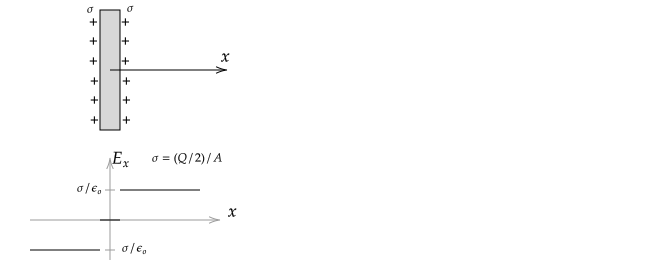
The potential will not change between because the electric field is zero inside of a conductor.
To get for , solve
Using and gives
Check: should be zero and the potential should decrease as increases.
To get for , solve
Using and gives
Check: should be zero and the potential should increase as increases.
It is quite easy to lose a negative sign when doing this computation. There are two ways to check your answer:
-
should be continuous
-
should decrease when you move in the direction of the electric field. Thus, I expect that as I move from to larger , should decrease because the electric field is in the direction. As I move from large negative towards the slab, I expect the potential to increase because I am moving against the electric field. (It may help to add field lines to the drawing above.)
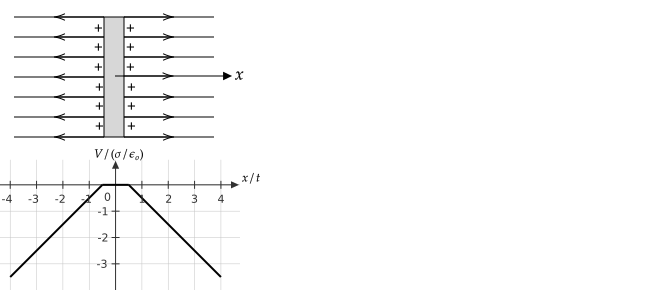
The electric field lines shown are for the field . Compute using and assuming for
-
Path 1
-
Path 2
Show and justify all steps in your calculation.
Partial Answer:
We expect the answers to be the same because the line integral of applies to arbitrary paths.
For a point charge at the origin, , the calculation of
was given in an example in the previous section and the result was
By convention, for point charges at any location, we always assume that , so can be solved for using
For a point charge not at the origin, the potential with respect to a coordinate system centered on the charge depends on the radial distance from the point charge to the point of interest:
where , is a vector from the origin to the point of interest and is a vector from the origin to the point charge. By convention, we usually omit the functional dependence in . Or, we write the functional dependence as because is usually fixed or given and we care about how varies relative to an origin that is not at the location of the charge. Thus, we usually write
Recall that the electric field due to a point charge at is
You have already shown that these two equations satisfy in HW #1, where you showed that .
A point is at . Compute .
Answer
A way of checking this equation is to note that the potential is expected to become large as you approach the position of a charge. Plugging in makes the denominator zero.
A point charge is at . A point charge is at . Write the equation for as the sum of for each charge and then use to compute .
Previously, differences in electric potential energy, , and electric potential, , were considered. Only differences in and are meaningful. However, in E&M, we often discuss and ; in this case, these quantities are relative to the respective quantities for a charge at infinity, in which case and are zero. That is, instead of discussing in the equation , we discuss , which is equal to because was chosen to be zero. A similar statement applies to .
Using this convention, the electric potential energy of a charge at a position that is a distance of from a charge is
In this formula, if the charges have opposite signs then is negative; if they have the same sign then is positive. Note that there is a sign associated with the potential energy but the direction of the vector that connects the charges does not matter; the equation for only involves the values of the charges and the magnitude of the separation distance between them.
Consider next the potential energy of charge when it is a distance from charge and a distance from charge . Work is required to move in the field due to and also the field due to . The total potential energy of is the sum of these works:
More generally, if there is a group of charges, the potential energy of charge is
Using , the electric potential at a point in space due to a group of charges is the sum of the potentials due to each of the charges at
In this equation, we have dropped the subscript from the positions because it is implied that all of the distances are relative to the location where we want to compute .
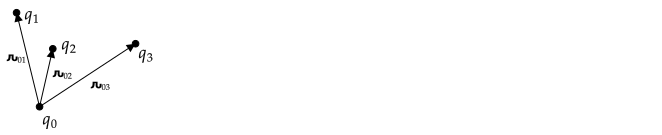
1. What is the potential energy of the charge in the diagram shown?
Answer:
This represents the amount of energy it would take to move charge from infinity to its position on the diagram.
2. What is the potential at the position of if that charge were to be removed (i.e., the potential due to charges , , and )?
Answer
Using ,
That is, the potential at a given location is found from potential energy of a charge at that location by dividing by the charge’s potential energy by the value of the charge.
3. Can you find the potential energy at the position of if that charge were to be removed? Why or why not?
Answer: No. It does not make sense to ask what the potential energy is at a point in space. Only physical objects (e.g., masses, charges) have potential energy.
4. Explain the difference between potential and potential energy.
Answer: A potential is a value associated with a location in space, and an electric potential is created by charges at all locations in space.
Potential energy is the energy associated with an object at a given location in space. The electric potential energy of a charge is the energy required to move it from a large distance away from all other charges to a given location in space. The electric potential energy of a charge at a point in space is related to the electric potential at that point in space by .
In the previous section, the electric potential . The quantity corresponds to the change in potential energy () of if it is moved from a reference location with to the point . This change in potential energy is also equal to the work required to move to .
When there are only two charges and separated by a distance , the work required to move them into position is , which is and also .
Another consideration is the energy required to create a charge distribution. This energy is denoted as in Griffiths. An example of a charge distribution is shown in the following figure.
-
is the work required to move to against the electric field due to all of the other charges. The other charges have been “preassembled”
-
is the work required to assemble a charge distribution.
To compute , for the following charge distribution, we need to compute the energy required to move each charge from infinity to their final position.

To compute the , we start by moving the left charge from infinity to its position at . There is no electric field, so no work is required.
To move into place, we must do work against the elecric field created by . This work is .
To move into place, we must do work against the electric field created by and . This work is + . Thus,
This can be generalized using the notation of Griffiths, where is the distance between and .
where , , and and , , and
For the following charge distribution, compute
-
the electric potential at the origin,
-
the electric potential at any position , and
-
the work required to assemble the charge distribution.

Answer
1. A common error was having a term in that was . The denominator of potential is a length, so it must be positive. Also, many student wrote an answer for part 2. that was correct but when was plugged in, they did not get the same equation they wrote for part 1.
1. and 2.
So the answer to 2. is
Plugging in gives the answer to 1.
3.