In this tutorial, flux is reviewed. The flux due to a vector field is a fundamental concept in E&M, but Griffiths only provides a 1–page description of the flux due to a vector field in the surface integral section in 1.3.1(b).
The flow of current also constitutes a flux and this is also introduced in this tutorial in section 3. This section may be skipped and will be revisited later in the semester.
Flux means “flow”. In this tutorial, the rate of flow (or flux) of particles, , (in units of # particles per second) and charge, , (in units of charge per second) past a point, line, and area will first be considered. These fluxes depend on a density and velocity.
Next, the flux, , associated with an electric field vector, , will be considered. In this case, the flux does not correspond to the flow of particles, but the calculation technique is similar to that for particles.
In this E&M, you will use the techniques covered here in two different ways:
-
To compute currents associated with the flow of charged particles.
-
To compute the flux associated with either an electric field vector or a magnetic field vector . In the development of E&M, Faraday and Maxwell supposed that and vectors produced a flux – in the case of , they spoke of “electricity flowing along a field line.” It was only later realized that there is no flow of “electricity” along a field line. An electric field only tells you about the force a charge would feel if placed at a point in space. An electric field line tells you about the direction of the force on a charge when placed somewhere on the field line. Although and fluxes are not associated with the flow of anything, the techniques used for calculating them is similar to those for particle fluxes.
This tutorial is primarily a mathematical review of flux and requires the use of normal vectors, which were reviewed previously in Vectors. You will use electric flux, , when Gauss’s law (Chapter 3) is covered, and magnetic flux, , when the Biot–Savart law is covered (Chapter 5) and also when Faraday’s law is covered (Chapter 7). Charged particle flux, , will be used when computing current distributions for use in the Biot-Savart law (Chapter 5).
Finally, electric and magnetic flux is a fundamental component of divergence and the divergence theorem, covered next.
In this section, the flux quantity is , which corresponds to a number of particles per second that flow past a point, line, or area.
The particles shown as dots travel at a velocity of 1 m/s to the right. What is , the number of particles that pass the X in one second?

Answer: In one second, all of the blue particles pass the point, so . More generally
where is the number of particles per unit length and is the magnitude of the velocity, both evaluated at the point.
The particles shown as dots flow outward from a source X at the origin with a constant velocity of 1 m/s. What is out of the gray region? Assume that flow out of the region corresponds to positive .

Answer:
The flux past is and past is . Both are postive because the flow is outward of the region. Based on the diagram, there are 6 particles in a length of 2 m, so . Thus,
To generalize this, we can state that the flux into or out of a linear region is
where the vector is defined to point outward from the region on its endpoints. With this convention, if is positive, there is a net flow out of the region; if is negative, there is a net flow into the region. We will use this convention also with flow past closed lines and closed areas.
Repeating this problem using ,
at , and , so
at , and , so
So the total flux out of the region between is
which is the same result found previously.
Particles flow as shown in the following figure. When a particle encounters the origin X, it is absorbed and does not continue to flow (another expression for this is “the origin is a sink”).

Use the equation to find the the flux into or out of the region between .
In this section, we consider computing the flux of particles through an open line (a line that does not form a closed loop) and then the flux of particles into or out of a region bounded by a closed loop.
Each of the particles shown as dots travels at a velocity of 1 m/s to the right. All of the particles are in the - plane. In one second, how many particles flow through the red line per second?
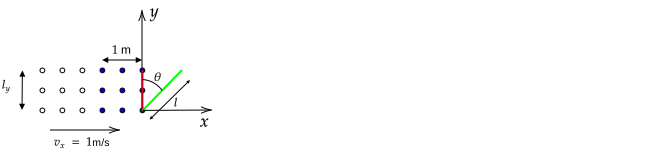
In one second, all of the blue dots pass through the red line, so particles pass through the rectangle per second.
In more general terms, we can write
where is the number of particles that pass through the line per second, is the number of particles per unit area, and is the length of the red line that particles pass through. From the diagram, the density is given by and so
as before.
Next, suppose we wanted to compute the number of particles that pass through the tilted green line per second. In this case, we note that that the number of particles per second that pass through the green line is the same as that for the red line. Although the green line is longer, we expect the flux to still be .
Note that in the previous paragraph, to find the flux through the tilted green line, we used a different line that was perpendicular to the velocity to compute the flux. Equivalently, we can multiply the component of velocity that is perpendicular to the green line by the length of the green line. That is, we break the velocity vector into two components – a component parallel to the line and a component perpendicular to it.
In the left-hand side of the diagram below, the velocity of one of the particles that is on the green line is broken down into components parallel and perpendicular to it. The right-hand side shows the flow of particles parallel to the green line, which does not contribute to the flux, and perpendicular to the green line, which does contribute to the flux.
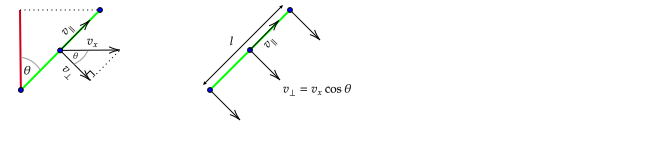
The component of velocity that is perpendicular to the green line is and so the flux through the green line is , where was used in the last step. This is the same answer as found previously.
In summary, to compute the flux through the green line, we could equivalently
-
Find the component of the green line that is perpendicular to the velocity; or
-
Find the component of the velocity that is perpendicular to the green line.
Using the definition of the dot product, , we can write
where is the length of the line to compute the flux through, and is defined to be perpendicular to the line through which the flux is computed. For a given line, two normal directions can be defined. As a result, if the computed is positive, there is a net flow through the line in the direction of ; if the computed is negative, there is a net flow through the line in the direction opposite of .
For , use the equation to find through (1) the red and (2) the green line.
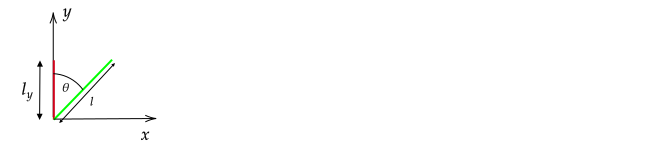
Answer
(1) For the red line, the line perpendicular to it that points to the right is , so
Because the answer is positive, there is a net flow across the line in the direction of the chosen direction of the normal vector (from left to right). If we would have chosen the normal vector to be , would be negative, and we would conclude there is a net flow in the direction opposite of (corresponding to right to left).
(2)
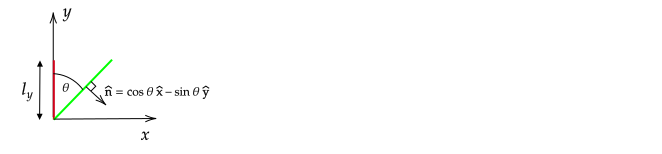
From the diagram above, a unit vector perpendicular to the green line is (this could be derived using the technique covered in Vectors, so
where was used in the last step. This answer is the same as that in part (1), which is expected because the same number of particles flow past the red line per second as flow across the green line.
For , use the equation to find through (1) the red and (2) the green line. Use the same normal vector as in the previous example.
If , compute through the green line.
Answer:
To answer this, we can use (a) superposition or (b) .
(a) Using superposition
In the previous problem, you computed when and should have found . In the first example, was computed for and found . In both cases, the same normal vector was used.
As a result,
(b) Using
which is the same as that found in part (a) using superposition. Recall that the sign of can be positive or negative depending on the values of the constants , , and . If is negative, it means that the net flow of particles is in the direction opposite to the normal vector drawn on the diagram above.
Suppose that and are not constant over the red line of length as depicted in the following figure.

In this case, we can first compute the number of particles that pass through an infinitesimal length on over which and are constant. Replacing with and with gives the flux through :
To find the total number that passes through , sum over all differential lengths on a line
If and ,
-
sketch particles with the given density and velocity variation and determine if the flux is expected to be smaller than, equal to, or larger than the flux if .
Then find the flux that
-
passes through the red line and
-
passes through the green line.
Answer:
1. The following diagram shows a density that is increasing linearly with and is zero when as was given in this problem. It also shows that the velocity does not change over the red line.

At the top of the red line, , and the density is . Because the density is lower on all other parts of the line, we expect the flux to be less than .
2. The flux that passes the red line is
This result is less than , which was expected. The fact that the answer is 1/2 of this makes sense because the average density on the line is .
3. The flux is expected to be the same as 1. From a previous problem as shown below.
There is a complication with this integral. The integration variable is the position along the green line, and depends on it. So we need to either write in terms of or vice-versa. Doing the former using the substitution in the previous integral gives
where was used in the last step. As expected, this is the same as found in part 2.
If and ,
-
sketch particles with the given density variation and velocity, determine if the flux is expected to be smaller, equal, or larger than the flux if .
Then find the flux that
-
passes through the black line and
-
passes through the green line.
Compute through the half–circle shown as a solid line. Use .

Answer
The easy way to solve this problem is to note that the number of particles that pass through the solid line in a given second must also pass through the dotted line (of length ). As a result, the flux is
The difficult way to solve this problem is to find the vector normal to the solid black line and then use
As covered in Vectors, the outward normal of a circle centered on the origin and in the – plane is , so , which is shown in black in the following diagram.

To be consistent with the previous calculation, we should multiply by so that we are computing the flux through the line with positive flux corresponding to flow from left to right. The corresponding normal vector is shown in blue in the diagram above.
Substition of , , and into the integrand for gives
In this integral, depends on the position along the curved line. As a result, we need to re-write the integrand so that either is written in terms of or is written in terms of . It is easier to do the former using . Substitution of this and using at and at the end of gives
which is the same result found using the easier method.
Particles with constant density flow with constant velocity as shown in the figure below.

Compute the flux through the circle using . Show your steps at the same level of detail as given in the previous problems.
A source of particles is at the origin that sends particles out radially and uniformly in all directions the – plane with a speed of . Assume that flow out of a circle corresponds to a positive flux.
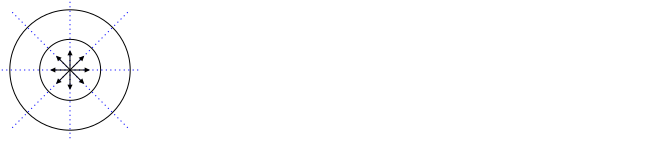
-
If the density of particles at the inner circle of radius is , what is through the inner circle?
-
What is , the density of particles at the outer circle of radius ?
-
What is through the outer circle of radius in terms of ?
Answer
1. . We could have used ; in this case , and the normal vector is , so the dot product reduces to .
2. On the diagram given, there are eight blue dots on both the inner and outer circles. (If the particles move outwards with a constant velocity, the number of particles on a circle of any radius will be the same). The outer circle is 2x longer than the inner circle, so the density of particles on it must be 1/2 of that on the inner circle. That is, .
3. , which is the same result as 1. This is expected - if the particles flow outwards at a constant velocity, each time a particle passes the outer circle, there is a particle behind it that passes the inner circle.
Summary of Results
For a source emitting particles with uniform speed in all directions in a plane, or a sink that absorbs particles with uniform speed in all directions,
-
the net flux through a closed loop is not zero when there is a source emitting particles inside of it,
-
the net flux through a circle of any radius centered on the source is the same, and
-
the density decreases in proportional to the distance from the source.
In fact, the net flux through a circle of any radius is the same even if the source is not at the center of the circle. This can be demonstrated with a diagram using two approaches.
Approach I – Using a Diagram

The above diagram shows particles flowing outwards at a constant velocity at a given point in time. The number of particles that pass the red line on the inner circle per second must equal the number per second that pass through the red line on the outer circle if the spacing between the blue dots is to remain constant. Given that this must be true if the particles flow at a constant velocity, we conclude that the flux through the inner red line must be the same as that through the outer red line. To complete the justification, note that this argument does not depend on the length of the inner red line - if it is a full circle, the same arguments apply, and we conclude the flux through the inner circle must equal that through the outer circle.
Approach II – Mathematically
The following details may be skipped.
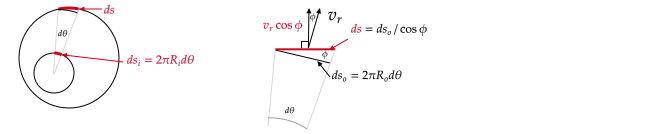
A mathematical way of showing this is to note that the inner differential length, , shown in the left of the figure above is so that the differential flux through is
and the outer differential length, , is so the differential flux through is
To show that , consider equating the last two equations. This gives the requirement that
or
This equation states that the density (number of particles per unit area) is inversely proportional to distance. This was shown to be true in the previous example.
A mathematical way of showing this is to note that the flux through the inner differential length, , shown in the diagram above is so that the differential flux through is
and the flux through the outer differential length, ,w is
Previously we argued that if the particles flow outwards with a constant velocity, then the number of particles on a circle of radius will be the same as that on a circle of radius so that
Subsituting this into the equation for gives :
To finish this problem, we need to show that the flux through the outer black arc segment in the right-hand side of the figure below (a repeat of that previously shown) is the same as that through the outer red arc.
Although visually it may be obvious that this must be true using Approach I, in the future, we will consider the flux of a general vector. In this case, we replace with a vector that is not related to the flow of particles and so Approach I is not valid.
The red line is longer than the black line, and is perpendicular to the black arc segment but not the red arc segment. The length of the red arc segment is and the component of perpendicular to it is . The flux through the red arc segment involves the product of its length and and as a result, the terms cancel and the flux through the red line is the same as that through the black line, as expected from Approach I.
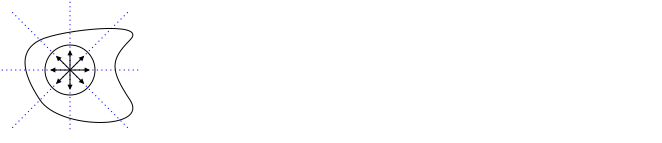
The aguments used in both Approach I and Approach II can be used to show that the flux through a closed line of arbitrary shape as shown in the figure below is also equal to the flux through a circle centered on the source.
Explain why the flux through a closed line of arbitrary shape is also equal to the flux through a circle centered on the source when particles are emitted from a source with a uniform speed in a plane.
Explain why the flux is zero through a circle that is outside a source that emits particles uniformly in all directions with speed in a plane.
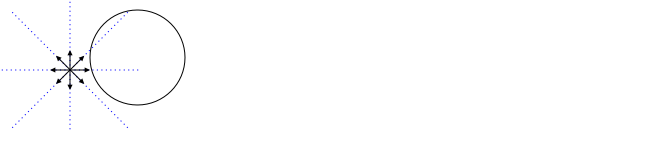
Does this result hold for a source that is outside of a close loop of arbitrary shape?
For a source emitting particles with uniform speed in all directions in a plane, or a sink that absorbs particles with uniform speed in all directions,
-
the density decreases in proportional to the distance from the source or sink.
-
the net flux through an arbitrary closed path that surrounds the source is not zero,
-
the flux through an arbitrary closed path that encloses a source or sink will be the same as that through a circle centered on the source or sink that is within the closd path, and
-
the net flux is zero through an arbitrary closed path that does not enclose a source or sink.
All of the above statements that apply to flow in a plane rely on the fact that is inversely proportional to the distance from the source or sink. In the case of electric flux, the analog to a source or sink is the electric field due to a positive or negative infinite line of charge, which has an electric field that is uniform in all directions and is inversely proportional to the distance from the line.
1. Explain why the flux through a closed line of arbitrary shape is also equal to the flux through a circle centered on the source when particles are emitted from a source with a uniform speed in a plane.
2. Explain why the flux is zero through a circle that is outside a source that emits particles uniformly in all directions with a speed in a plane.
3. Does result 2. hold for a source that is outside of a closed loop of arbitrary shape? Briefly justify your answer.
Answer
-
If we imagine each dot as a person in a line walking radially outwards, every time a person passes the circle, another person passes the outer curve. (Some students mentioned that there may be a delay between when a person passes the inner line and a person passes the outer line due to the gaps. One needs to imagine that the people are packed very closesly together so that if there is a delay, it is nearly zero. Alternatively, one can state that the long–term average of the number per second of people that pass the outer and inner lines will be the same.)
Several students attempted to provided advanced arguments that omitted key parts. In general, if a diagram was given to accompany their arguements, the flaw or missing part of their argument would have been clear. The more advanced argument requires the use of Approach II mentioned in the Flux notes.
-
Argument 1. applies here.
-
To prove that the flux is the same for both closed loops in 1. is the same, one would need to use Approach II in the notes on flux. The same approach will work in showing that the flux through the circle (or any closed loop shape) is zero when the source is outside of the closed loop.
The generalization from flux through a line to flux through an area is straightforward. Suppose the following is the cross-section of a three-dimensional diagram.
If the dots are uniformly spaced into and out of the page, and the red line is the side view of a square that goes into the page by , then particles pass through the red square per second per unit of area of the red square.
In more general terms, we can write
where is the number particles that pass through the rectangle per second, the number of particles per volume (instead of per area) and is the cross-sectional area that particles pass through (instead of the length of a line that the particles pass through). Using this equation for the diagram given above assuming the red line is the side of a square with area of ,
The most general equation for flux through an area is
where here the normal vector is a vector that is perpendicular to the surface and the integral is taken over the area of interest. Note that often the definition is used to write this as
Previously, a source of particles that emitted particles with a uniform speed in all directions in a plane (2–dimensional flow) was considered.
Here we suppose a source emits particles uniformly in all directions with a uniform speed in three dimensions. Think of a light bulb at the origin that emits photons in all directions, and think of the photons as the particle. Or, think of a bunch of tiny people at the origin who throw baseballs.
A source at the origin emits particles with a uniform speed in all directions.
1. Explain why the density of particles, is inversly proportional to the square of the distance from the origin.
2. Explain why the net flux through an arbitrary closed surface that surrounds the source is not zero,
3. Explain why the flux through an arbitrary closed surface that encloses a source or sink will be the same as that through a the surface of a sphere centered on the source that is fully within the arbitrary closed surface.
4. Explain why the net flux through an arbitrary closed surface that does not enclose the source or sink is zero.
In the case of electric flux, the analog to a source or sink is the electric field due to a positive or negative charge, which has an electric field that is uniform in all directions and is inversely proportional to .
See current.md
The videos 1 and 2 describe most of what is covered in this section. See also your textbook for Physics 260. This topic is briefly covered in the surface integral section in 1.3.1(b) of Griffiths.
In the previous sections, the flux due to the flow of particles was considered. In this section, we are going to stop thinking about the flow of particles and speak only of the “flux due to a vector.” In place of , we are going to use a vector .
In general, the electric flux past a point or line is not a quantity of interest. In this section, only the flux through an area is covered.
For the flow of particles through an area, recall that the number of particles that pass it per unit time was found to be
where is a particle density (particles per unit volume).
Electric flux is defined by (by convention, a mathematical definition is indicated by )
where is the electric field at , a small patch of area on a surface ; the vector is multiplied by a unit vector that is normal (perpendicular) to . Note that the subscript on the integral is often omitted; it is typically used when we want to refer to an area in a diagram or in the text describing an equation.
As before, there are two normal unit vectors to any surface. If is found to be positive, then we say that the flux is in the direction of the normal. If is found to be negative, then we say that the flux is in the opposite direction of the normal. Under certain conditions described below, the flux equation simplifies to
Using the definition , another way of writing this is
where is the component of that is perpendicular to the surface. (The notation here may be a bit confusing – the dot product results in the component of that is parallel to , so it may seem strange that we use the perpendicular subscript. The reason we call it is that it is the component of perpendicular to the area.)
If the being used to compute the flux is closed, then we write the integral with a circle:
When the surface is closed, there is no ambiguity in the direction of the normal – by convention, it is always the one that points outward from the volume enclosed by .
An integral equation must be used if the integrand changes over the surface . That is, if either the electric field magnitude or its direction changes on a surface , then we must use the integral equation.
To see this, rewrite the integrand using the defintion of the dot product , where is the angle between and :
where is the angle between the normal unit vector and and the fact that a unit vector has a magnitude of was used. From this, we conclude that if either changes on the surface or if the angle between and the normal vector at any point on the surface changes, integration is required.
In part (a) of following figure, a 3-D view of two planes are shown. The planes are in a region of space where the electric field is constant and in the -direction. Part (b) shows the planes when viewed from a position on the -axis; from this view, electric field lines are horizontal.
Compute through the two areas.
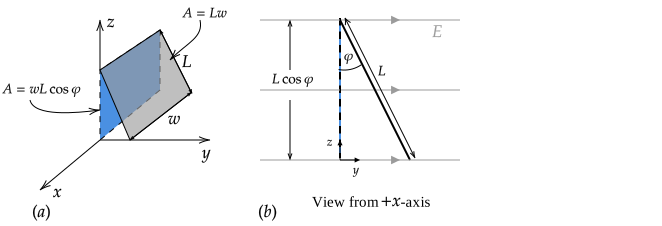
In this problem, the electric field magnitude and direction does not change on either surface, so the integral equation is not needed.
Approach I – Using
For the blue surface, and and so
For the gray surface, we need a diagram to compute the electric field perpendicular to it.
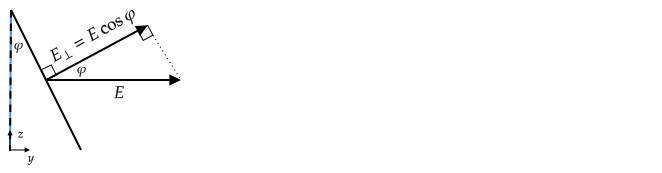
From the diagram, and the gray area is , so
which is the same as the flux through the blue plane.
Approach I – Using
was given and for the blue plane, , and , so
For the gray plane, . From the diagram below,
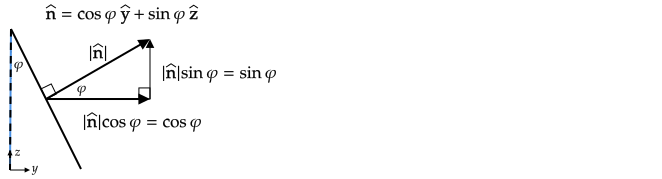
Substitution gives
Note that an alternative way of computing is to use the fact that the plane is perpendicular to the tilted line, find the equation for the tilted line, and then use the equation for to a line covered in Vectors.
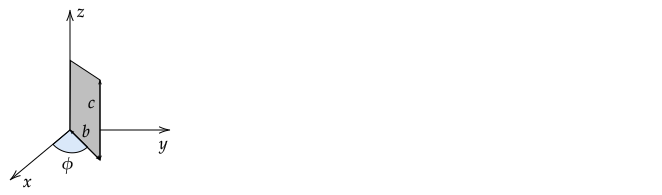
What is the magnitude of electric flux through the plane when
-
The electric field has a magnitude of and is in the -direction.
-
The electric field has a magnitude of and is in the -direction.
For both parts, check that your answer makes sense by asking what the expected answer is when and/or .
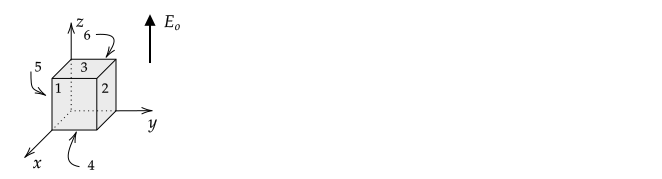
Find the flux through the six labeled faces of the cube with side length when the electric field is everywhere in the direction.
Answer
This will be solved using two methods. The first is a more visual method. The second is more mathematical. Although the mathematical complexity of the second method is not really needed for this problem, it allows one to solve the next problem without an additional diagram.
Method I
The electric field is parallel to surfaces 1, 2, 5, and 6. Thinking in terms of the analogy of the electric field representing lines of flow, the flux is zero through these faces.
By convention, the normal direction for surface 3 is outwards from the volume, which is in the -direction. The electric field is in the same direction, so
The normal direction for the bottom surface is downwards, which is in the opposite direction as the electric field, so
The total flux through the cube, , is zero. Thinking again in terms of the electric field representing flow lines, every electric field line that enters the cube exits, so the flow in equals the flow out.
Method II
Conveniently, the normal vectors are parallel to the Cartesian unit vectors. Based on the diagram, , , , , . The negative sign for the last three normal vectors is due to the convention that the normal points outwards from a closed surface.
The area vector is the area times the normal vector, so , , , , , and , where .
Recall that and the dot product of any other combinations of Cartesian unit vectors is zero: , , and .
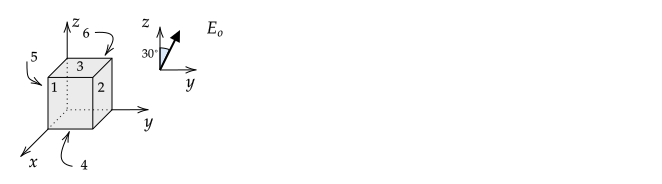
Find the flux through the faces of the cube, which have area , when the electric field is at an angle of to the -axis towards the -axis.
Answer
Method I
The electric field is parallel to sides 1 and 6, so
When using this method, it is necessary to draw a diagram to ensure the calculations are correct. In the following, the cube viewed from a point on the -axis is shown.
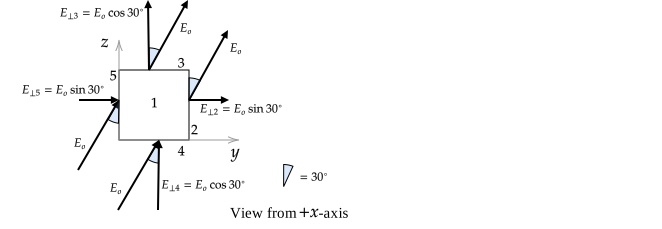
The above diagram was used to compute the electric field perpendicular to the side faces.
The negative signs in the last two equations were inserted based on the diagram which shows the electric field points into the volume.
Method II
Based on the diagram in the problem statement, , , , ,
Also from the diagram,
.
What remains is to evaluate dot products (you should be able to skip most of the intermediate steps). Using ,
Check: The flux is positive for faces 2 and 3. This is consistent with the previous figure because if electric field vectors point outward from the volume. The flux is negative for faces 4 and 5, which is consistent with the diagram because the electric field vectors point into the volume.
Find the flux through each of the faces of the cube with side length when the electric field is at an angle of with respect to the -axis towards the -axis.
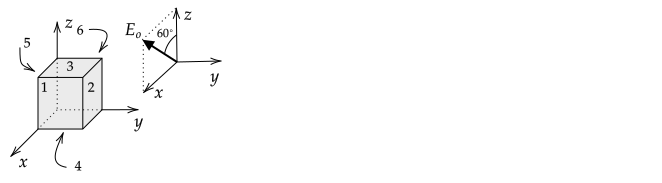
Answer:
The total flux is zero, as expected using the flow analogy.
A spherical shell of radius is centered on the origin and cut in half. A view from the –axis is shown on the right of the following figure.

Compute with . Justify all of your steps.
Answer:
In this problem, the magnitude of the electric field is constant on the surface, but its direction changes with respect to a line that is perpendicular to the surface. As a result, we must use the integral form and add the fluxes on each differential area element.
A differential element on the surface on a sphere is of radius is . The normal vector is . Thus
Dotting this with gives
.
To do the dot product when the terms have unit vectors in different coordinate systems, in general, we need to write both in the same coordinate system. This means either writing with spherical unit vectors or with cartesian unit vectors. However, for , we can use a short–cut. The dot product of two vectors is the product of the magnitudes of the vectors multiplied by of the angle between the two vectors. If you draw a diagram of and , you should see that the angle between them happens to be the spherical angle . As a result, we can immediately write . Using this,
.
The last step is to do the integration. Here we integrate over from to and from to .
Integrating over and factoring out the constants gives
The integral evaluates to , so
Check: Because the electric field is the same everywhere and using the field line/particle flow analogy, we expect that if the shell had a circular cap on the bottom, the flux through the cap would be the same magnitude as the flux through the shell but negative. The field is perpendicular to the cap but in the direction opposite to the normal vector, so , as expected. (Later, we will see that even with an electric field that was not uniform, the fluxes would still add to zero provided that there are no charges inside the closed surface formed by the shell and cap.)
A related problem is to compute the flux through a full sphere. You can do this without calculation by drawing the electric field and using symmetry. At each point on the top of the sphere, there is a differential element with a positive flux that is equal and opposite to a differential element with a negative flux on the bottom part of the sphere. As a result, the answer is zero for a closed sphere.
Alternatively, from the field line/particle flow analogy, the net flow in must equal the net flow out, so the answer should be zero.
A disk of radius is centered on the origin and in the – plane. Sketch the vector fields
1.
2.
3.
Then, starting with the equation , compute using for each vector field.
Justify your steps at the level of detail given in the example problems. Recall that a differential element of area on a disk is .
If , find the flux through the surface of a sphere centered on the origin of radius
Answer:
Although the electric field direction changes on the surface of the sphere, we do not need integration. Earlier it was stated that if the either changes on the surface or if the angle between and the normal vector at any point on the surface changes, integration is required. Here the normal vector to the surface of the sphere is , which is always aligned with , because its direction is also given by . In addition, on the surface of a sphere, the electric field magnitude does not not change – it is . Thus, both conditions that are needed to avoid integration are satisfied.
1.
2.
A key observation is that because the field decreases in proportion to and the area increases in proportion to , the flux, which involves the product the the field and the area, is independent of the radius of the sphere. This is analogous to the case where there is a source that emits particles at the origin – the density of particles decreases in proportion to .
Repeat the previous problem by starting with . Show and justify your steps at the level of detail given in previous examples.
A cylindrical shell (like a toilet paper roll with caps added to ends) is sliced in half as shown on the left of the following figure; on the right, a view from the +–axis is shown.
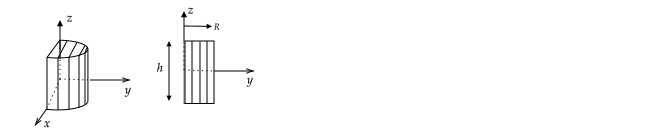
If ,
1. compute the magnitude of the electric flux through the surface using . Justify all of your steps for the three integrals that must be evaluated (two caps and curved surface). Recall that a differential element of area on the curved surface of a cylinder of radius is and a differential element on a disk is ; and
2. what is the magnitude of the electric flux through a full cylindrical shell with caps? Justify your answer if you answer without doing a calculation.
Answer:
For the top, , so . As a result the integrand is zero becuase .
For the bottom, , so . As a result the integrand is zero becuase .
For the curved surface, . To do a dot product of this with , we either need to write in cartesian or in cylindrical. Using , gives the dot product . The integrand can be written as . Using , we need to perform the integral
This flux is expected because it is also the flux through the open rectangular area, which has an area of . The field does not change between this rectangular area and the curved surface, and so the flux through each must be the same.
Find the flux through one of the faces of a cube that is centered on the origin due to an electric field of . (It will be shown using Gauss’s law that the answer is . However, in this problem, do the integration.)